Oven Repair
Viking Self-Clean Lockouts in Marblehead: The Order to Check Things
A Viking door still locked after self-clean is nearly always waiting on cool-down rather than broken. Work through it in order — the wait, the panel, the mechanism, the code, the collateral — and most Marblehead lockouts resolve before anyone books a visit.
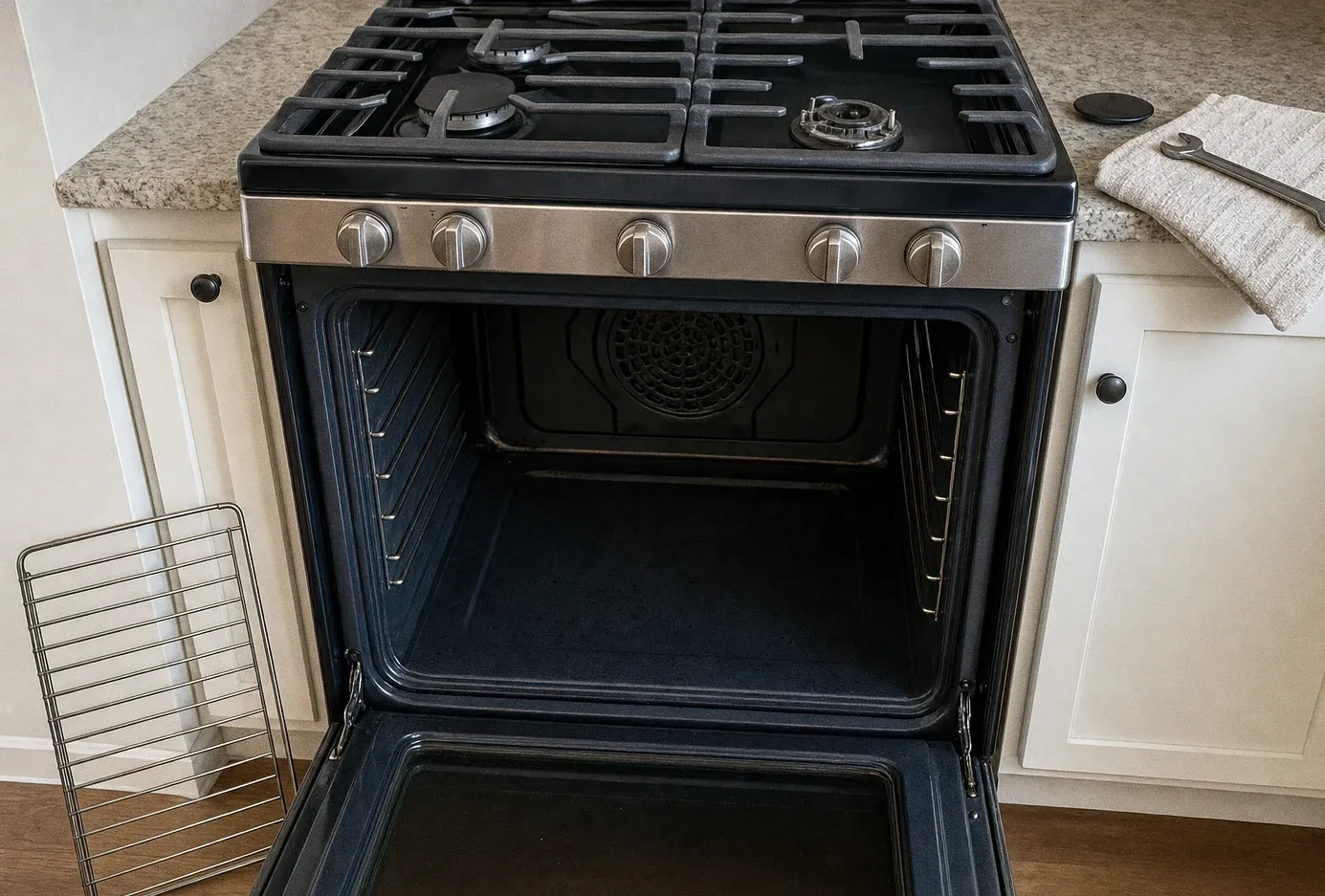
Almost every call about a door that will not release after a clean cycle arrives too early. The appliance is not being stubborn and nothing has necessarily failed; it is finishing something the display stopped narrating a while ago. Working through this in order — the wait, then the panel, then the mechanism, then the code, then whatever else the heat found — costs nothing and settles most of these without a visit.
First: how long is it supposed to stay locked?
Longer than feels reasonable, and the wait is not optional. The release is granted on a temperature condition rather than a clock: the control holds the door until the cavity has dropped back under the threshold it is watching for, and since the clean phase takes the interior well beyond any cooking setting, that fall runs on for hours past the point the cycle reports itself done.
What that looks like from the kitchen is undramatic. A fan may still be turning with the appliance apparently doing nothing. A lock indicator sits lit on the panel. The glass is warm rather than hot, and the trim above it is warmer than the glass. That combination is an appliance mid-procedure, not one in trouble.
Use the time to observe. Is the display lit? Is the lock symbol on? Is anything audible? Has a code appeared, and if so, at what point? Patience stops being the correct answer once the cavity is at room temperature, nothing has been audible for a long stretch, and the door is still held.
Marblehead sharpens the stakes on all of this. In Old Town, where kitchens sit in low-ceilinged rear ells off lanes barely wide enough for a van, there is rarely a second cooking cavity anywhere in the house — the one that is locked is the one you were going to use. The same is true on the Neck, where a rebuilt kitchen tends to concentrate everything into a single wall of equipment.
A blank display changes the diagnosis
Read the panel before you read the door, because three panel states mean three different things. Lit with a lock indicator is an appliance doing its job. Lit with a code is an appliance reporting something. Dark and unresponsive means power is your first problem and the door is your second.
For a dark panel, start at the breaker. A controlled power cycle — off, a full minute, on again — is a legitimate test and a poor repair. If the display returns and the door releases, you have learned that the control needed to re-evaluate the latch from scratch. If nothing comes back at all, the board is not being fed.
A thermal fuse is the commonest reason for that. It is a one-shot protective device placed where excess heat has to be intercepted, and it does not reset: once it has opened, it stays open until it is replaced. Finding a blown one is not finding a defect. It is finding the component that did precisely what it was fitted to do, and the useful question becomes what pushed it there.
Which is also why repeated trips to the breaker panel are not a strategy. Resetting a circuit that has already interrupted itself is looking for a second failure to go with the first.
The mechanism behind the door
Two components and one argument. A small motor drives the lock across the door; a switch reports back where the lock actually finished up. The appliance refuses to open — and refuses to heat — for as long as the switch’s report and the control’s instruction fail to agree. Apparent stubbornness is usually that mismatch.
The two versions of it feel different from the outside. Where the motor never ran, the end of cool-down passes in silence and nothing about the door changes. Where the motor ran and the switch never confirmed, there is a short mechanical sound and then the same result, because the control will not act on a confirmation it never received.
Heat supplies a third version. Everything in that assembly expands and contracts through a cycle that hot, and metal does not always return exactly to where it started. Add residue baked hard into the track the bolt travels along and it can bind short of home, which from the kitchen is indistinguishable from an electrical failure.
That is the end of the homeowner’s part. The mechanism sits inside a hot, high-current appliance and reaching it means dismantling; our Oven Repair page describes what happens once it is open.
The code on the display, read honestly
Codes are observations rather than diagnoses. A control can tell you that a temperature reading is implausible, or that the lock never reported itself engaged. It cannot tell you which of the several possible causes behind that observation is the one you own, and treating a code as a part number is how people buy components they did not need.
So record it before doing anything else. Photograph the panel. Note the exact characters, and note whether the code sits steady or flashes. A power cycle wipes it, and there is no recovering it afterwards.
Afterwards, the useful distinction is persistence. A code that clears and does not return through a normal cycle described a moment that has passed. A code that reappears within seconds of the panel waking up is describing a condition the control is measuring right now, and it will keep describing it until the condition changes.
What else the clean cycle may have taken with it
A clean cycle finds anything marginal. Heating elements with a fault too small to matter at roasting temperature give up at clean temperature. Control relays that have switched reliably for years stick on the cycle that finally asks too much. Door seals harden and lose the squeeze that made them seal.
That is why a door can release perfectly and the appliance still be wrong afterwards. If it opens and then runs cold, preheats far too slowly, or browns heavily down one side, the lockout was the smaller half of the story. On the seaward streets of Peach Highlands and out toward Swampscott, hardware also lives in salt air, and fastenings and hinge pins in an appliance that has just been through a very hot cycle are not helped by it.
Fine grey ash on the cavity floor and a light haze on the glass are normal; wipe both out cold. Scorch marks, discolouration around an element, or a smell of hot insulation lingering after the ash smell has gone are not.
What a technician can do that you cannot
Stop waiting and pick up the phone for any of three things: a burning-electrical smell, a breaker that trips again after a reset, or a door still held when the appliance has been stone cold for hours.
A visit settles what observation cannot. Whether the protective fuse still passes current. Whether the lock motor receives an instruction, and what it does when it gets one. What the board is recording internally, as distinct from what the panel has chosen to display. Those three measurements separate a fuse from a latch from a control, and nothing in the kitchen distinguishes them.
Do not force the door. The lock is built to hold a heavy door against thermal load, and it will hold against a screwdriver too — right up until something bends. Levering converts one failed part into a damaged latch, a distorted door and a much larger bill.
The service call is $95. Published bands run $250 to $800 for an oven thermostat or heating element and $400 to $870 for a control board or touch panel, and which one applies is a diagnosis, not a guess. We cover Old Town, Marblehead Neck and Peach Highlands, and you can reach us on the number shown above or through the booking link.
Still asked on the phone
Is self-clean bad for the oven?
Not bad, but demanding. It is the hardest thing the appliance ever does to itself, and it finds components already close to the end of their lives — elements, relays, seals. That is an argument for using the cycle thoughtfully rather than avoiding it: run it when the kitchen is not needed, ventilate the room, and do not read a failure during the cycle as proof the feature caused it.
Should I run self-clean before a holiday?
It is close to the worst possible timing. The cycle needs a long heating phase and then a long cool-down before the door releases, and if something marginal gives way you have lost the appliance on the day you most needed it. Clean well ahead instead — a quiet weekend with nothing depending on the result — so any repair can be arranged without pressure.
How long should the door stay locked after a self-clean cycle?
Longer than the cycle itself, and the figure that matters sits in your model's guide rather than in general advice. Release is granted on temperature, not on a timer, so the wait depends on how hot the cavity became and how quickly the kitchen carries that heat away. Treat it as normal until the appliance is cold to the touch and has been silent for hours.